— Proven Real Estate Solutions
What every California Realtor and Seller needs to know about the new California Real Estate Media Law AB 723.
The New Standard: Navigating California’s AB 723
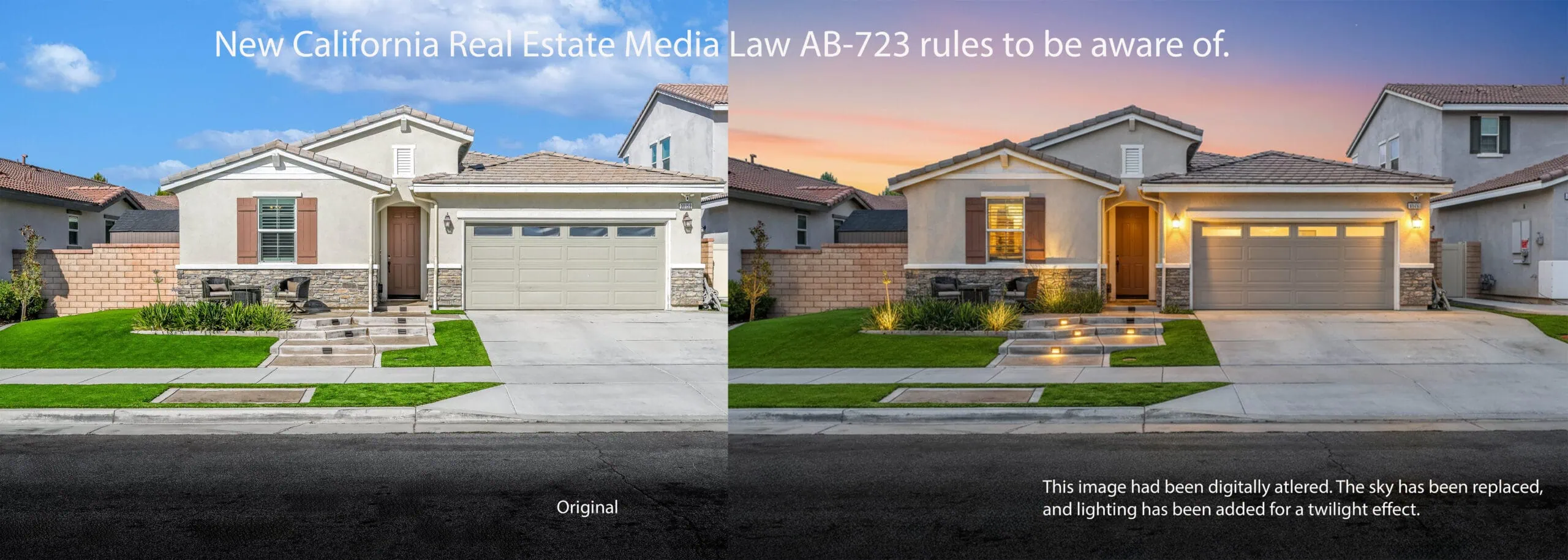
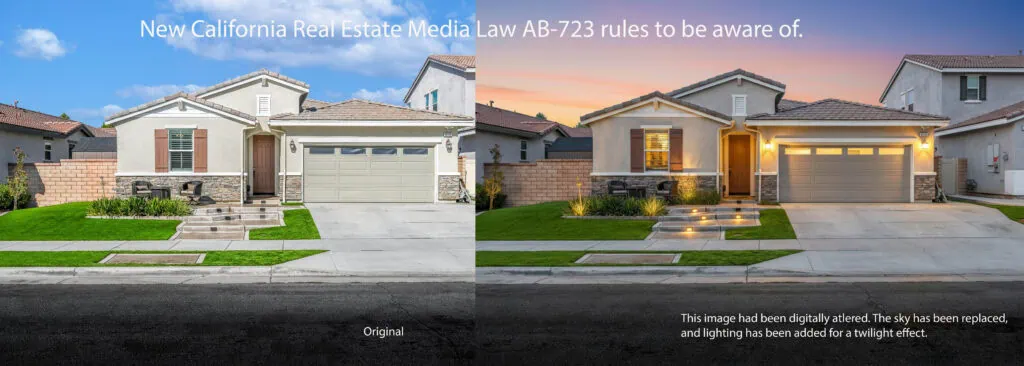
California is setting a new national precedent for transparency in property marketing. On October 10, 2025, Governor Newsom signed Assembly Bill 723 (AB 723) into law.1 Effective January 1, 2026, this legislation fundamentally changes how real estate media is produced and presented, mandating clear disclosures for any “material” digital alterations to property images.2
As AI-driven tools like virtual staging and “sky-swapping” become the industry norm, AB 723 aims to ensure that what a buyer sees online aligns with what they find at the front door.3
What the Law Requires
The core of AB 723 is simple: if you change the physical representation of a property in a photo, you must tell the consumer and show them the truth.
- Disclosure Statement: Any advertisement or promotional material (digital or print) featuring a “digitally altered image” must include a statement that is “reasonably conspicuous” and located on or adjacent to the image.4
- Access to Originals:
- On Controlled Websites: If a broker or agent controls the website where the image is posted (e.g., a personal or brokerage site), they must include the original, unaltered version of the photo in the same posting.5
- In Print or Third-Party Ads: For flyers or platforms not directly controlled by the agent, the ad must provide a link, URL, or QR code that directs the consumer to a publicly accessible page containing the original images.6
“Better” vs. “Different”: What Counts as Altered?
The law distinguishes between professional enhancements that improve image quality and alterations that change the property’s substance.7
| No Disclosure Needed (Standard Edits) | Disclosure Required (Material Changes) |
| Lighting & Exposure | Virtual Staging (adding furniture/décor) |
| Color Correction & White Balance | Removing “eyesores” (utility poles, wires, debris) |
| Image Sharpening | Changing fixtures, flooring, or paint colors |
| Straightening & Cropping | Modifying landscaping (adding green grass or plants) |
| Angle Adjustments | Altering views or neighboring structures |
Impact on Real Estate Media
For photographers and videographers, the workflow is shifting from “perfection” to “transparency.”
- Dual Delivery: Media companies must now provide agents with both the final edited/staged files and the “raw” originals to ensure the agent has the assets needed for compliance.
- Metadata and Watermarking: We may see an increase in automatic watermarking for virtually staged photos (e.g., “Virtually Staged”) to help agents meet the “conspicuous” requirement without extra manual work.
- Video and 3D Tours: While the bill explicitly mentions “images,” the spirit of the law and existing “Truth in Advertising” codes (BPC § 10140) suggest that AI-generated walk-throughs or modified video frames will face similar scrutiny.
Responsibilities for Realtors and Sellers
Compliance falls squarely on the licensed broker or salesperson, or anyone acting on their behalf (such as marketing assistants).
Transparency as Trust: Embracing these disclosures can actually build trust. Buyers are often more skeptical of “perfect” photos; showing the “before” and “after” can highlight the home’s potential without feeling like a “catfish” situation.
For Realtors: * Audit Your Workflow: Ensure your MLS uploads include the original “before” photo at the end of the carousel.
Review Print Media: Update flyer templates to include a QR code linking to a “Transparency Gallery” or the original photo set.
License Risk: A “willful violation” of the Real Estate Law can be treated as a public offense and may lead to the suspension or revocation of your license.
For Sellers:
Approval of Media: Sellers should review how their home is being represented. While virtual staging is still a powerful tool to sell a “lifestyle,” sellers should be aware that buyers now have a legal right to see the home’s current condition side-by-side with the vision.
New Real Estate Disclosure Law for 2026
This video provides a deep dive into the legal ramifications of AB 723, specifically focusing on how AI-edited images and virtual staging are impacted for California licensees.